The Patek Philippe Nautilus Ref. 5726/1A is one of those watches that rewards the collector who looks past the obvious.
The Patek Philippe Nautilus Ref. 5726/1A is one of those watches that rewards the collector who looks past the obvious. It sits in a lineup dominated by the 5711, the clean, time-only Nautilus that has become arguably the most talked-about steel watch of the past decade. But spend time with the 5726/1A and it becomes clear this is the better value.
To understand it fully, you have to go back to 1996. At that year's Baselworld fair, Patek Philippe unveiled something the watch world hadn't seen before: the Annual Calendar. The complication sits between two existing solutions to a long-standing problem. Standard mechanical watches with date functions require manual correction five times a year, at the end of every short month. Perpetual calendars solve this entirely, automatically accounting for every month length including leap years, but they are extraordinarily complex and expensive to produce.
Patek's answer was elegantly logical. The Annual Calendar automatically distinguishes between 30- and 31-day months, requiring the owner to intervene just once a year, on March 1st, to advance the date past the end of February. Patek Philippe patented the complication and, in doing so, created an entirely new category of watchmaking.
For its first fourteen years, the Annual Calendar lived exclusively in precious metal dress watches. Then in 2010, Patek did something unexpected: they put it in the Nautilus. The Reference 5726 became the first steel Patek Philippe to ever carry the Annual Calendar, a complication that had previously been considered the territory of formal watches. Placing it inside Gérald Genta's iconic sport case changed what the Nautilus could be.
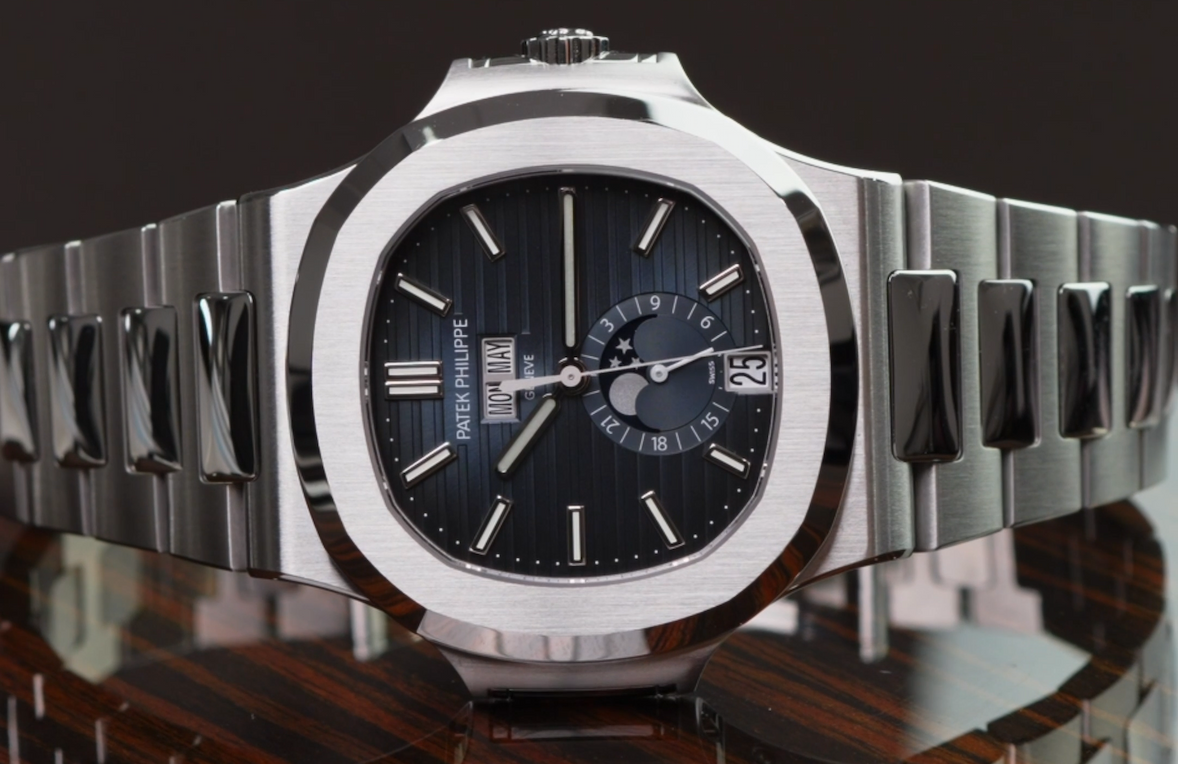
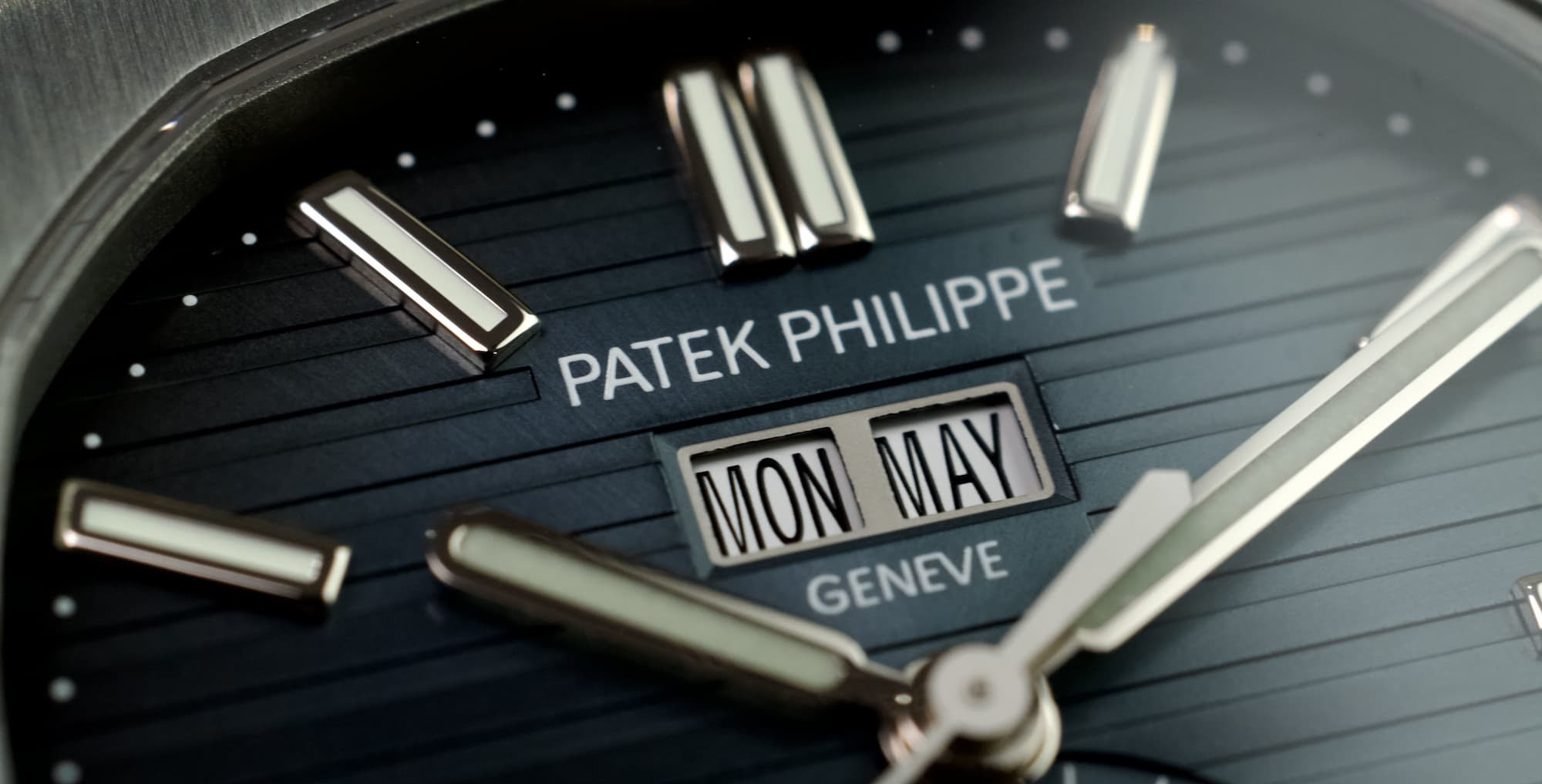
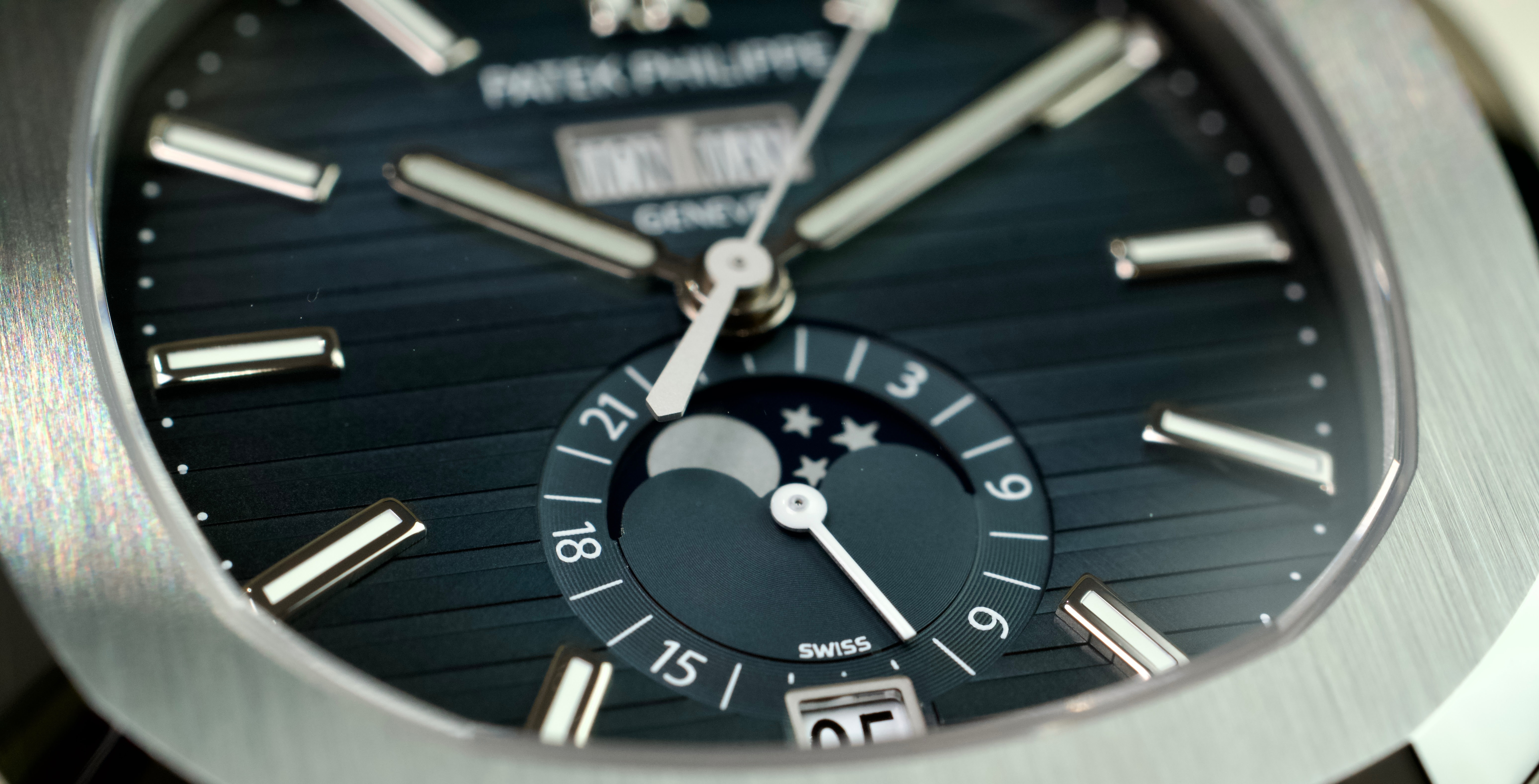
The steel bracelet version, the 5726/1A, followed in 2012. The dial layout Patek chose for it has become one of the more admired in the collection. Day and month appear through two aperture windows just below 12 o'clock. The date sits in a window at 6 o'clock. Above it, a subsidiary dial houses both a 24-hour AM/PM indicator and a moon phase display, one accurate to within one day every 122 years.
In 2019, Patek retired the earlier black and white dial versions of the 5726/1A and introduced the blue gradient dial of the 5726/1A-014. The color was a deliberate callback: the graduated blue-to-black finish references the original blue dial of the very first Nautilus, the Ref. 3700 of 1976. The same horizontal embossing that has defined the Nautilus dial since the beginning is present here, giving the complex calendar layout depth and structure.
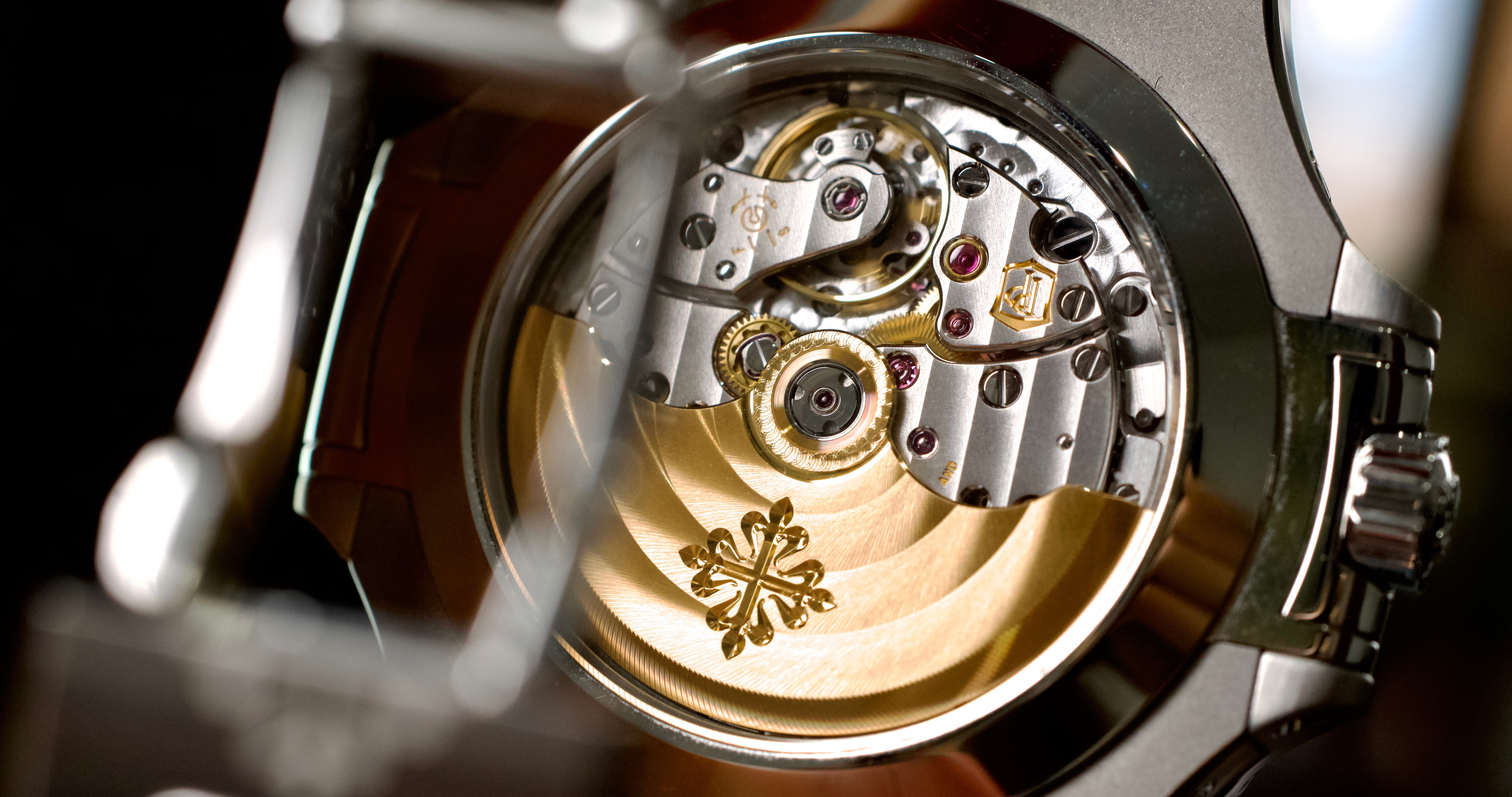
Inside sits the Caliber 26-330 S QA LU 24H, an in-house self-winding movement beating at 28,800 vibrations per hour with a power reserve of 35 to 45 hours. It comprises 339 components, uses a Gyromax balance and Patek's own Spiromax balance spring, and is wound by a 21-karat gold central rotor. The movement is finished to exhibition standard, which is why Patek fits the 5726/1A with a sapphire crystal caseback. It carries the Patek Philippe Seal, the brand's proprietary quality certification, which in several respects sets stricter standards than the official Swiss Chronometer designation.
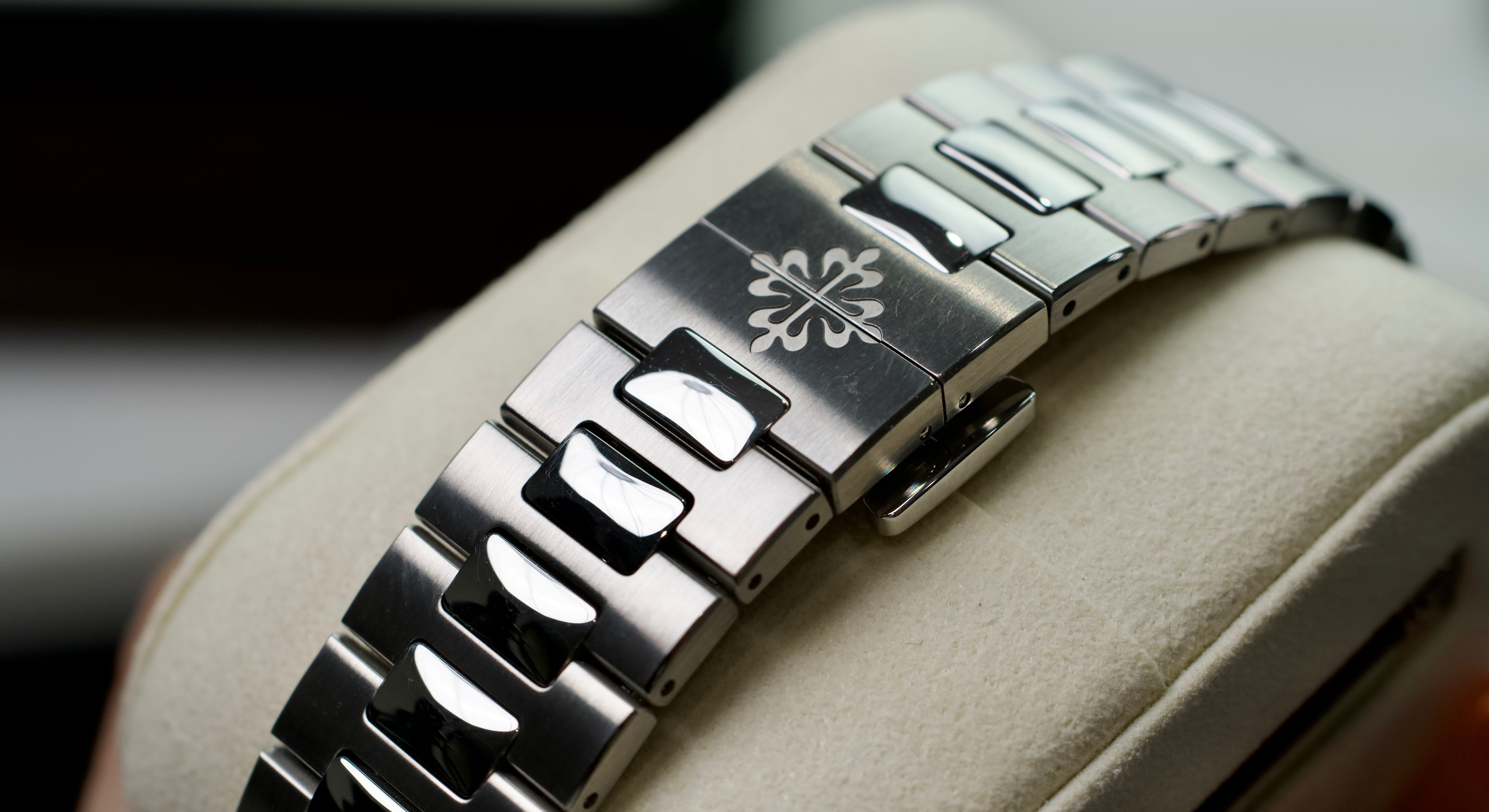
What makes the 5726/1A easy to overlook is the same thing that makes it interesting. It isn't the flashiest watch in the Nautilus family. It doesn't have the cultural moment the 5711 had, or the novelty of the more recent introductions. What it has is substance: a genuine horological complication, one of the best dials in the current collection, and the kind of wearability that comes from a 40.5mm steel case.
For collectors who have been watching the Nautilus market closely, the 5726/1A has gradually earned its own following, appreciated for exactly the reasons it was initially underestimated.
